

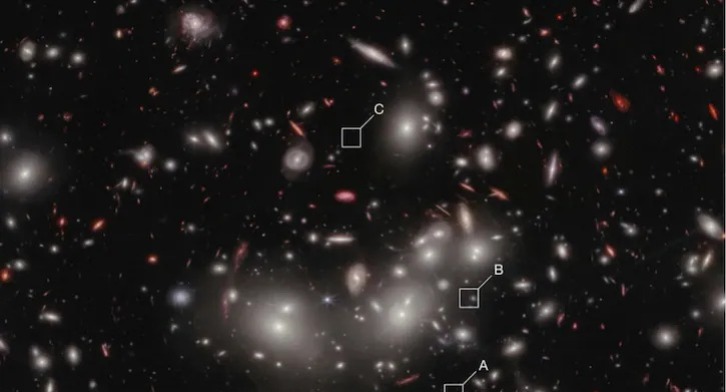
Scientists using the James Webb Space Telescope have uncovered evidence suggesting that some supermassive black holes may have formed already massive in the early universe, challenging long-held theories about their origins.
For decades, astronomers believed that black holes formed when massive stars collapsed and gradually grew by absorbing matter and merging with other black holes. However, new observations indicate that certain supermassive black holes may have skipped this process entirely.
The discovery centres on an object known as QSO1, a member of the “Little Red Dots” class of cosmic objects that existed just 700 million years after the Big Bang. Using Webb’s Near Infrared Spectrograph, researchers studied the motion of gas surrounding the object and found clear evidence of a massive black hole at its centre.
The team estimates that the black hole has a mass roughly 50 million times that of the Sun and accounts for at least two-thirds of the object’s total mass. Researchers also found that the surrounding gas consists mainly of hydrogen and helium, indicating it formed in the universe’s earliest stages.
The findings could reshape scientists’ understanding of how the universe’s largest black holes emerged so quickly after the Big Bang.