

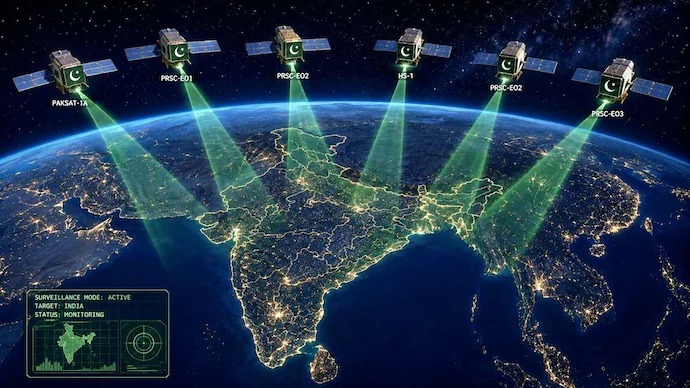
Pakistan has significantly accelerated its space surveillance capabilities, launching six Earth-observation satellites within a span of just 16 months. The rapid expansion, achieved with substantial support from China, is drawing attention from defence analysts who believe it could strengthen Islamabad’s ability to monitor military and strategic developments across India.
The latest satellite launches mark a major shift for Pakistan’s space programme. Historically, the country’s space agency, SUPARCO, maintained a modest presence in orbit, launching only a limited number of satellites over several decades. However, between January 2025 and April 2026, Pakistan successfully deployed a series of advanced Earth-observation satellites equipped with high-resolution imaging, remote-sensing technologies, and artificial intelligence-based data processing systems.
Among the most notable additions is the HS-1 hyperspectral satellite, capable of identifying different materials and detecting objects that may not be visible through conventional imaging systems. Other recently launched satellites, including PRSC-EO2 and PRSC-EO3, are designed to provide enhanced monitoring and frequent observation of specific regions.
Experts suggest that the true strength of these satellites lies in their combined operation as a constellation. Working together, they can deliver regular imagery updates, track changes on the ground, and improve situational awareness over strategically important areas. Reports indicate that some satellites have been placed in orbits that allow repeated coverage of South Asia, including northern India and Jammu & Kashmir.
China’s role has been central to this development. Beyond providing launch services, Beijing is believed to have contributed technology, technical expertise, and satellite development support. Analysts argue that integration with China’s extensive Earth-observation network could further enhance Pakistan’s intelligence-gathering capabilities.
For India, the development highlights the growing importance of space-based surveillance in modern security planning. While India remains one of the world’s leading space powers with far more advanced capabilities, experts caution that regional competitors are rapidly improving their own military-space infrastructure.
As surveillance, intelligence, and reconnaissance increasingly shift beyond Earth’s atmosphere, space is emerging as a critical arena of strategic competition. Pakistan’s expanding satellite presence, backed by Chinese expertise, underscores how future security challenges may be shaped not only by developments on land, sea, or air, but also by the assets orbiting above them.