

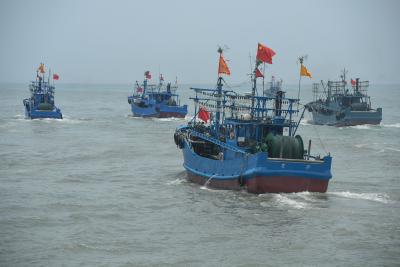
Washington: US lawmakers have accused China of being the world’s largest perpetrator of illegal, unreported and unregulated (IUU) fishing, warning that Beijing’s state-backed fishing operations pose a serious threat to global food security, marine ecosystems and US national security.
The findings were released through a joint investigation by John Moolenaar, Chairman of the US Select Committee on China, and Carlos Gimenez, Chairman of the House Homeland Security Committee’s Transportation and Maritime Security Subcommittee. The probe details how China operates the world’s largest distant-water fishing fleet, estimated at more than 16,000 vessels.
According to the investigation, China uses its vast fishing armada to intimidate other nations, deplete fisheries worldwide and exert control over global seafood supply chains. Lawmakers alleged that the fleet functions as a strategic tool of the Chinese Communist Party (CCP), rather than a commercial enterprise.
The Select Committee on the Chinese Communist Party said the fleet relies heavily on forced labour and widespread human rights abuses, while China dominates seafood processing globally. The report noted that over 80 per cent of seafood consumed in the United States is imported, with a significant portion dependent on supply chains controlled by China.
Moolenaar said the investigation exposed how unregulated fishing has been used by the CCP to manipulate the global food supply. He warned that vulnerabilities in food supply chains leave the US exposed, adding that coordinated action with allies is essential to counter China’s exploitation of the oceans.
Gimenez described China’s fishing fleet as “a weapon of the Chinese Communist Party,” arguing that its operations directly impact US national security. He said China uses its fleet to strip resources from developing nations, destroy marine ecosystems, exploit forced labour and dominate global seafood markets.
“Our laws were designed to regulate fishermen, not to confront a subsidised, state-run fleet built to evade enforcement and project power,” Gimenez said, calling for stronger measures to address what he termed economic coercion through seafood supply chains.
The investigation further revealed that China has removed distance as a constraint on fishing by developing a global network of processing hubs, giving it a permanent, state-supported cost advantage. Lawmakers said this dominance has weakened US seafood processing capacity and increased American dependence on Chinese-controlled supply chains.
The committee concluded that the findings point to a deliberate, state-directed campaign by the CCP to achieve maritime dominance, monopolise food systems and undermine the rules-based international order, posing a direct threat to US economic sovereignty, national security and global stability.