

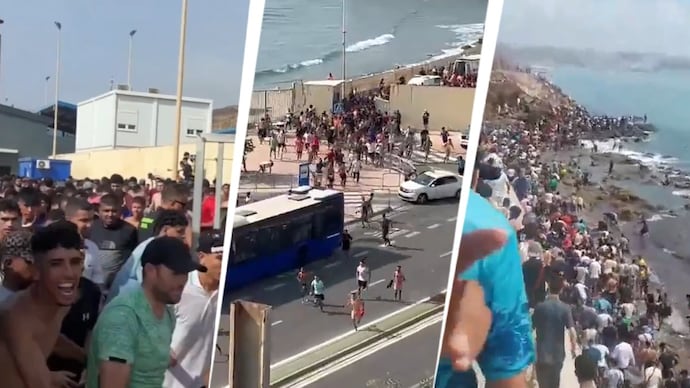
Madrid: Around 60,000 migrants entered Spain’s North African enclave of Ceuta over two days, creating an unprecedented humanitarian and political crisis after thousands swam across the maritime border, climbed fences and crossed into the territory from Morocco.
Spanish authorities said nearly 48,300 migrants had been returned to Morocco by Friday afternoon, while rescue teams continued operations after dozens reportedly died attempting the dangerous sea crossing.
The sudden influx followed weeks of mobilisation on social media, where migrants reportedly shared information about sea conditions, crossing routes and even swimming gear. According to multiple reports, some migrants took swimming lessons or purchased flippers and wetsuits in preparation for the journey.
Several migrants claimed Moroccan security personnel directed them towards Ceuta. One migrant told international media that officers repeatedly pointed towards the Spanish territory, saying, “Go that way.” However, other reports showed Moroccan police attempting to block people from reaching the border, using water cannons, restricting transport and stopping travellers heading north.
The shortest route to Ceuta spans only a few hundred metres across the sea, but strong currents and overcrowding forced many to remain in the water for hours, increasing the risk of drowning.
The mass movement has sparked political debate across Europe over border security, migration management and humanitarian responsibilities. Analysts believe the surge was driven by a combination of economic hardship, online coordination and uncertainty surrounding recent legal developments related to migrant returns from Spanish territory.
Spanish and Moroccan authorities continue to monitor the situation as efforts intensify to restore order along one of Europe’s most sensitive external borders.