

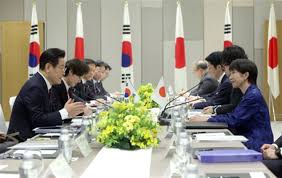
Nara: South Korean President Lee Jae Myung on Tuesday underscored the growing importance of cooperation between South Korea and Japan, citing an increasingly complex and volatile international environment, during summit talks with Japanese Prime Minister Sanae Takaichi.
Speaking at the outset of the talks, Lee said that despite the painful historical legacy stemming from Japan’s occupation of the Korean Peninsula, both countries must work together toward a better future. “Amid a complex and dizzying international order, I believe that cooperation between Korea and Japan is more important than ever,” Lee was quoted as saying by Yonhap News Agency.
The meeting came shortly after Lee held summit talks with Chinese President Xi Jinping in Beijing earlier this month, against the backdrop of heightened tensions between China and Japan over Takaichi’s recent remarks on Taiwan.
Lee noted that South Korea and Japan have built mutually beneficial relations over the past six decades since normalising diplomatic ties and expressed hope that bilateral relations would continue to deepen over the next 60 years. He also called for expanded cooperation in areas such as artificial intelligence, the economy, society, culture and people-to-people exchanges.
Highlighting global challenges, Lee said geopolitical uncertainty is intensifying, multilateralism is under strain, and interdependence in global supply chains is increasingly being weaponised. “To address the pressing challenges we face, I hope that the two countries will squarely confront history while expanding cooperation based on deep mutual trust,” he said.
Prime Minister Takaichi, in her remarks, said she would work closely with President Lee to promote regional stability and expressed hope that his visit would help further elevate Seoul-Tokyo ties.
Lee arrived in Nara for a two-day visit as part of reciprocal leader-level visits known as “shuttle diplomacy,” aimed at maintaining recent momentum in improving bilateral relations. The two leaders had earlier met on the sidelines of the Asia-Pacific Economic Cooperation forum in Gyeongju in late October and again briefly during the G20 leaders’ summit in South Africa in November.