

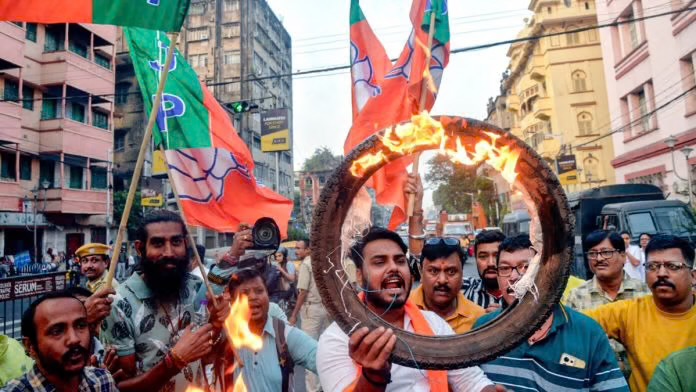
Kolkata: The Bharatiya Janata Party (BJP) on Saturday alleged that the recent violence in Beldanga, a minority-dominated area in West Bengal’s Murshidabad district, was instigated in a pre-planned manner by falsely portraying the suicide of a migrant worker in neighbouring Jharkhand as a case of murder.
BJP IT Cell chief and the party’s central observer for West Bengal, Amit Malviya, cited the post-mortem report of Alauddin Sheikh, issued by the Jharkhand Police, to claim that the death had been conclusively established as suicide.
According to Malviya, violence that continued for two consecutive days in Beldanga was triggered by the rapid spread of unverified allegations of murder without waiting for factual confirmation.
“The unrest followed the unnatural death of migrant labourer Alauddin Sheikh in Jharkhand. Without waiting for facts, claims of murder were aggressively pushed, triggering violence and intimidation,” Malviya said in a statement posted on social media.
Quoting the post-mortem findings, Malviya said the report recorded the cause of death as ante-mortem hanging and noted the absence of any ante-mortem injuries, abrasions, bruises, fractures or signs of assault.
He added that the findings were officially confirmed by Palamu district Superintendent of Police Reshma Ramesan and were also reported by local media in Jharkhand.
Malviya further claimed that the deceased’s family had expressed satisfaction with the Jharkhand Police investigation after receiving the body. He alleged that despite clear medical and investigative evidence, a “coercive narrative” was allowed to dominate, leading to prolonged unrest in the area.
The BJP leader also said that none of the deceased’s fellow migrant workers in Jharkhand had alleged murder in their statements recorded by a special team from the Beldanga Police Station, which had travelled to Palamu as part of the investigation.
“Kasim Shaikh, who brought the body back, did not allege foul play. The deceased’s cousin, Ersad Shaikh, also stated that there was no indication of murder. The family was kept informed throughout the process, including through video calls. The post-mortem and inquest reports ruled out assault,” Malviya said.
Raising questions over the unrest, Malviya alleged political motives behind the violence. “Who engineered the rumour that spread faster than verified facts? Who benefited from blocking highways and railway lines? Why was mob violence allowed to shape the narrative before forensic truth emerged? Why were journalists attacked, and why was the administration absent for hours?” he asked.
“The answers lie in vote-bank politics,” Malviya alleged.