

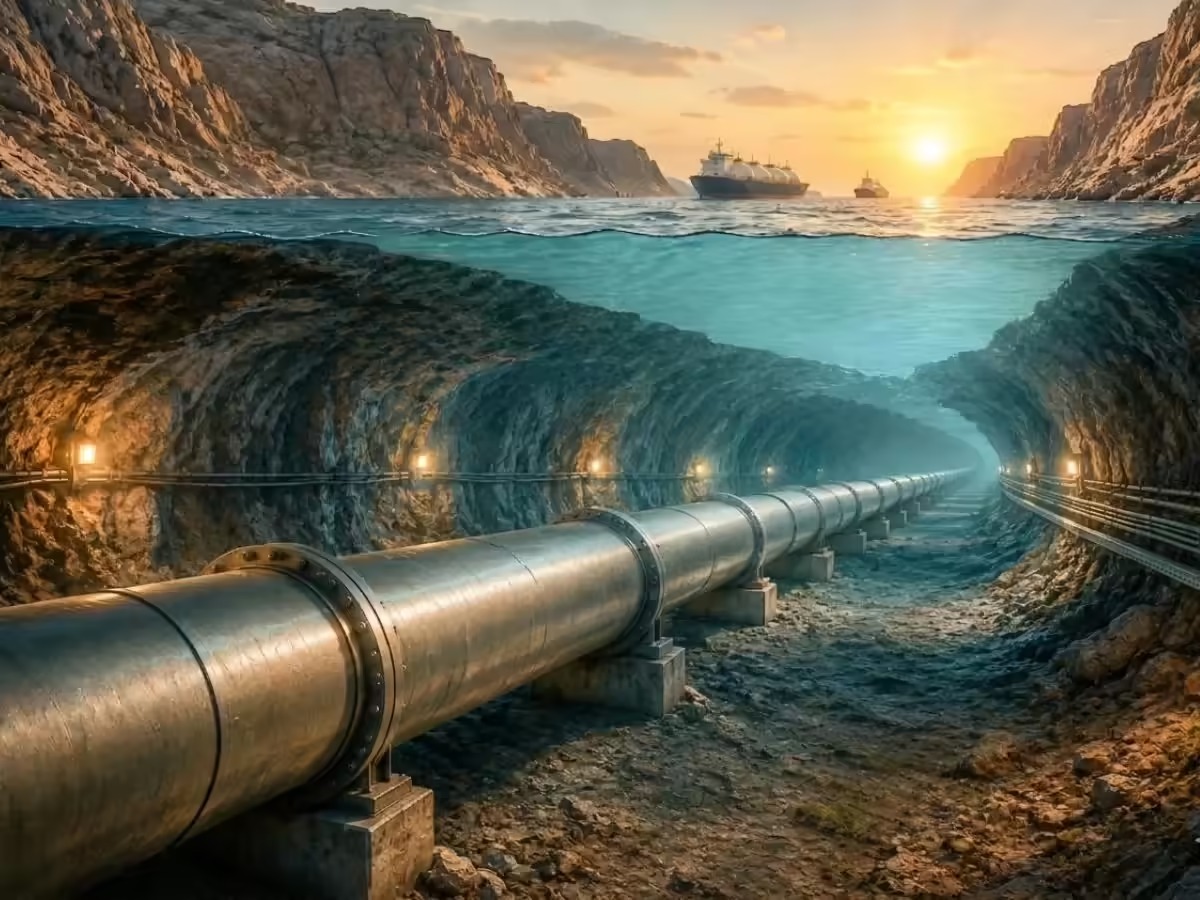
India’s quest for long-term energy security has brought renewed attention to an ambitious infrastructure proposal that could reshape the country’s energy landscape—a deep-sea natural gas pipeline connecting Oman to Gujarat across the Arabian Sea.
Stretching nearly 2,000 kilometres underwater, the proposed pipeline aims to establish a direct energy link between the Gulf region and India’s western coast. Estimated to cost around ₹40,000 crore, the project would transport natural gas from Oman directly to India, reducing dependence on liquefied natural gas (LNG) shipments and vulnerable maritime routes.
The proposal is not new. Discussions around an Oman-India gas pipeline have been ongoing for more than three decades. Earlier attempts failed to move forward due to high costs, technological limitations, and concerns about commercial viability. However, changing geopolitical realities and advancements in offshore engineering have revived interest in the project.
One of the pipeline’s biggest advantages is its potential to reduce India’s exposure to disruptions in the Strait of Hormuz, a critical global energy chokepoint through which a significant share of India’s imported energy passes. Any instability in the region can affect fuel prices, shipping costs, and supply chains. A direct subsea pipeline could provide a more stable and predictable source of natural gas.
The project’s engineering requirements are extraordinary. Parts of the pipeline would be laid at depths exceeding 3,000 metres below sea level, making it one of the deepest subsea energy projects ever attempted. Such conditions require advanced technology, specialised construction methods, and sophisticated maintenance systems.
Despite its strategic appeal, several challenges remain. The enormous capital investment, uncertain future gas prices, and long-term demand projections will influence the project’s commercial feasibility. Financing arrangements and international cooperation will also play a crucial role in determining whether the proposal moves beyond the planning stage.
Government agencies and energy companies are currently examining the project’s feasibility. If approved, the pipeline could strengthen India’s energy resilience while deepening economic ties with Oman and the broader Gulf region.
Beyond natural gas, experts believe such infrastructure could eventually support the transportation of cleaner fuels, including hydrogen, aligning with future energy transition goals.
As India seeks reliable and diversified energy sources, the Oman-Gujarat Deep-Sea Gas Pipeline represents a bold vision. Whether this long-discussed project becomes a reality will depend on the successful alignment of technology, economics, and strategic cooperation in the years ahead.