

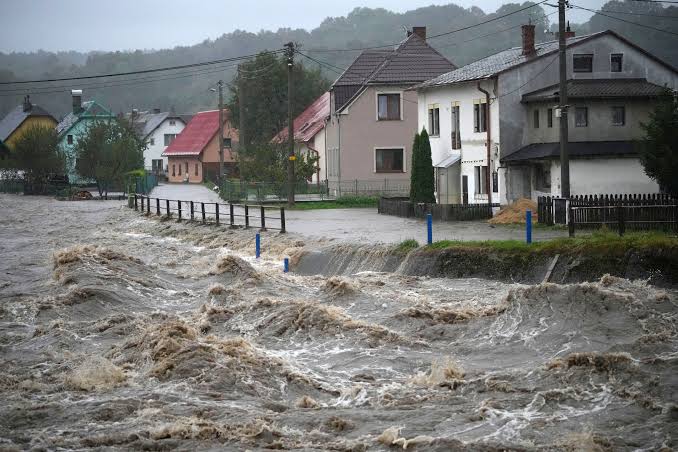
Bucharest: Romania’s National Institute of Hydrology and Water Management (INHGA) on Friday issued a red flood alert for the Niscov River in Prahova and Buzau counties due to rapidly rising water levels following persistent heavy rainfall.
The high-risk warning, valid until 3 p.m. local time (1300 GMT), indicates that river levels may exceed critical danger thresholds, posing a serious flood threat.
In addition to the red alert, authorities placed the Teleajen River in Prahova County and rivers across the Milcov basin in Vrancea County under an orange alert until noon local time. A yellow alert was also activated for parts of the Barlad River basin in eastern Romania. Romanian hydrological authorities classify flood warnings in three escalating levels — yellow, orange and red — to signal increasing severity and risk.
Emergency alerts have been issued to residents in vulnerable communities. In Prahova County, firefighters responded to multiple calls to pump water from flooded yards; however, no structural damage to homes has been reported.
In Buzau County, swelling waters on the Niscov River have cut off road access to the village of Mierea, leaving 12 residents across four households isolated. Local officials confirmed that these residents remain safe with adequate supplies.
Earlier this week, Romania’s National Meteorological Administration (ANM) had issued a Code Yellow warning for severe cold and frost, impacting more than half the country, including the capital, Bucharest. That warning, effective from Monday morning until Tuesday, brought heavy snowfall to Bucharest and several southern regions, creating hazardous winter driving conditions.
ANM had forecast a sharp cold snap through early February, with night temperatures dropping as low as –15°C in mountainous depressions and daytime highs failing to rise above freezing in parts of northeastern Romania. Lowland regions were expected to see rain while higher elevations above 1,500 metres were forecast to experience sleet and snow.
By early February, colder air had spread nationwide, with temperatures in northern Moldova falling between –7°C and –10°C during the day. The weather agency also noted that February is likely to bring continued snowfall and mixed precipitation, particularly across northern, central, and eastern areas of the country.
The combination of intense rainfall and ongoing winter weather has elevated flood risks across multiple river basins, prompting authorities to maintain heightened vigilance.